
Emergency water removal in Allen, TX
Emergency water removal is the first few hours after water hits your floor, in the order they actually happen.
Emergency Line(972) 544-433924/7 emergency line. Free estimates from local pros.
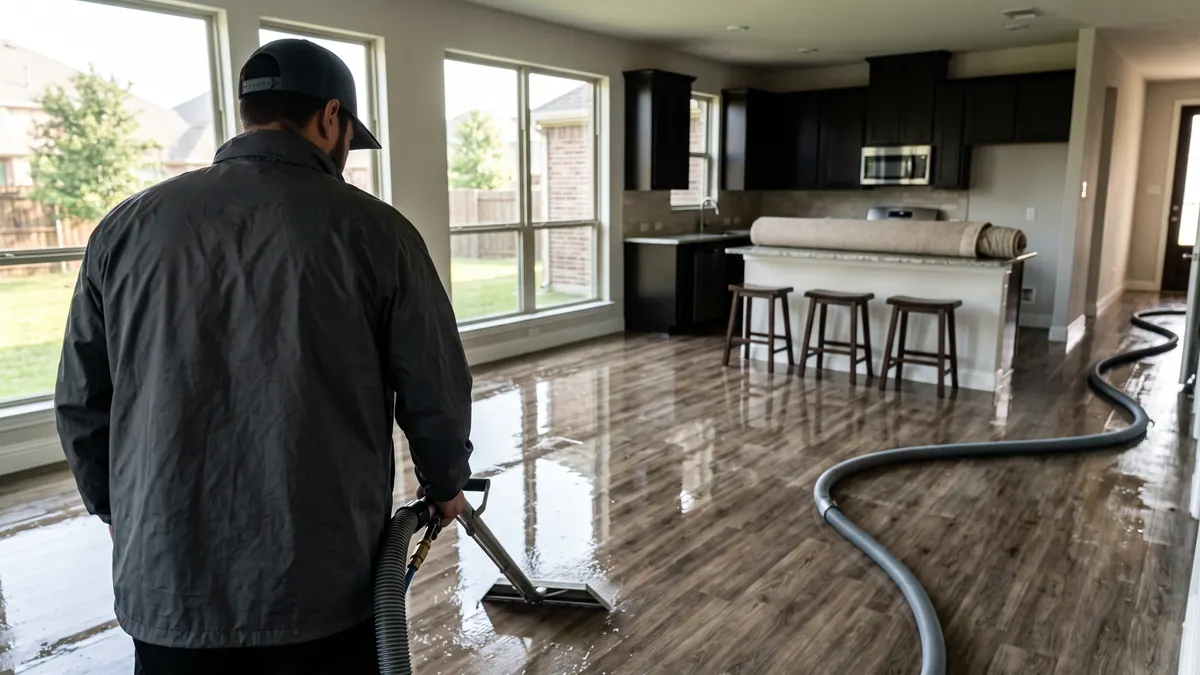
When water hits your floor, emergency water removal is what happens over the next few hours: getting it up, finding out where it traveled, and deciding what needs to move first. In an Allen house, that work usually splits two ways. A local crew handles the extraction itself. You handle a short list of things before they get there.
Day three: dry floors and quiet machines
Here’s what it looks like when the first hours go right. Three days in, the drying equipment is getting packed up instead of still running. A moisture meter reads normal through the wall where water once sat. Somewhere on a phone or a counter is a folder of photos, dated the day the water showed up and dated again the day drying started. Getting to that point means going backward from here, one stage at a time.
Twelve hours back: extraction and mapping
Before floors can read dry, the standing water has to come out, and a local crew brings equipment built for that job: pumps and extraction units that move gallons in minutes, not the slow work of a fan and a stack of towels. Once the visible water is gone, mapping starts. A moisture meter checks what a glance can’t: how far the water actually pushed into drywall, baseboards, and the subfloor under a floor that already looks dry on top. That reading decides what dries in place and what has to come out, a question the water damage repair page charts once the drying side finishes.
One hour back: water off, power checked
Shut the water off at its source if you can get to it safely. The fixture’s own little valve beats the main shutoff when you know exactly what failed. If standing water sits anywhere near an outlet or a plugged-in appliance, that circuit needs to come off at the panel before anyone wades through it. Furniture and boxes sitting right in the water are worth moving to dry ground next, ahead of anything that’s only damp.
Before any of it: what’s yours to do
Towels and a box fan or two won’t dry a room on their own, but they buy time. Press towels flat against standing water to pull up what you can reach, and point a fan across the wet spot to keep air moving until extraction equipment shows up. That’s the realistic limit of what a household can do here. Pulling water fast and confirming how far it spread is built for equipment a house doesn’t keep in a closet.
The photo that starts the file
A phone photo of the water, taken as soon as you see it, becomes the first dated entry in a claim’s timeline. A second photo once drying equipment is running gives that file its second date. Most of what an adjuster asks about later sits between those two points, and the what to do guide puts a timeline on everything else that happens in between.
The two dates an adjuster will ask about
An adjuster reviewing this claim later will want two timestamps: when the water started, and when drying started. Everything above exists to make both of those easy to answer. The one fact worth having ready before you call is simpler than either: where the water is actually coming from. What’s wet, how far it traveled, and what needs equipment instead of a fan can all get sorted out on the line once that much is clear. The drying time guide zooms in on how those two dates end up shaping the schedule that follows.
Common questions
Does anyone answer if this happens in the middle of the night?
Yes. This line takes calls any hour, including overnight, since water damage doesn't wait for business hours. Who ends up on your job depends on which local company can take it in the Allen area, not what time it is.
How long does it actually take to dry out?
It depends on what got wet, how far the water traveled, and what the air in the room is doing to help. A single wet closet can read dry in a couple of days; a whole room with soaked drywall usually takes longer. The site's drying time guide walks through what actually sets that number.
Should I stay in the house or leave?
Most people can stay if the water hasn't reached an outlet, a panel, or a light fixture, and the air doesn't smell off. If any circuit near the wet area is still live, or something about the air feels wrong, it's safer to wait somewhere else until a local crew checks it.
Related pages
Appliance Leak Cleanup
The plumber fixes the tank. This page is about everything the leak reached on the way down.
Learn more →Burst Pipe Cleanup
Where the water landed, inside a wall, under a floor, or through a ceiling, decides how a burst pipe gets cleaned up.
Learn more →Ceiling Water Damage
When a ceiling stain shows up tells you almost as much as where it is.
Learn more →Commercial Water Damage
A business with water on the floor runs on a short chain of decisions, and whoever's on site starts it, not the owner.
Learn more →Talk to a local pro now
We answer 24/7. One call gets a Allen crew moving on your water damage, with a free estimate and help with your insurance claim.
Emergency Line(972) 544-4339Free estimates. No obligation to hire.